Category: Pontifications

  • Can’t Abide

    Work Work Work Work Work

    I started working at 13. A few days a week after school I bused tables, delivered drinks and food, took drink orders, cleaned and vacuumed at the end of the night, and handled cash at my uncle’s restaurant inside the El Monte Airport in the San Gabriel Valley – now renamed the San Gabriel Valley Airport. The minimum wage at the time was $6.75 an hour. For a 13 year old that felt like real money – enough to buy almost anything I wanted, which at that age was mostly CDs and music gear.

    What I remember most from that time was the feeling of being in the real world. School felt like a false reality, full of tedious drama and conflict from students and teachers alike. Work was different. People treated me with common respect. They spoke to me like a person. I was building actual skills, meeting actual people, having actual experiences.

    I worked in restaurants and a cafe through high school and into my twentieth year, from my uncle’s place to a local cafe where I learned to make coffee and espresso, and eventually Rod’s Grill, a 50s diner in Arcadia that operated for 70 years before closing in 2024. I worked there from the age of 17 to 20.

    During that time I was getting out into the real world more and more. I started studying music at Citrus College at 17 and outside of work and school I was playing a lot of music, often gigging on the weekends and going on adventures further and further away. I talked about some of these times in my entry for Our Golden Days Have Passed – and I will write in more detail about these times in future entries. I was taking less hours at the restaurant and eventually stepped away altogether to focus on traveling, just a few months before I left for Europe on a one-way ticket.

    From that point on I never took on a regular job again. Over the next year and a half on the road I sustained myself through minimalist living – couchsurfing, hitchhiking, sleeping outside, “dumpster diving” – and work exchange wherever I could find it. The summer of 2013 I worked across Ireland on a farm and homestead and in a couple of hostels and guest houses. In one summer I worked with horses and sheep, cleaned rooms and bathrooms, made beds, pulled weeds, painted sheds, helped prep and serve dinners and more. Hours of labor in exchange for a place to stay, food, and whatever else came with it. I continued seeking similar opportunities as I kept traveling across twenty-odd countries over the next few years. I did small money gigs here and there and even turned down opportunities for steadier paying work to keep moving.

    Those experiences changed something fundamental in how I think about work, time and money. Living simply, traveling on almost nothing, what I needed to be happy became pretty clear: food, shelter, people, nature, music. That’s about it. If I gave a few hours of my day to sustain a lifestyle I loved – even without making much (or any) money – that felt like a fair trade. I started to understand the difference between basic needs and higher needs. There are many things far more valuable than money.

    Traveling and returning to the US made this even clearer through contrast. The sense I got from many people I met across Europe was that their jobs were a means to an end rather than the end itself – people prioritizing close relationships with friends and family, meeting up daily as a matter of routine. My mom worked two jobs for most of my life and vacation wasn’t part of our vocabulary. Many Europeans receive nearly a month of paid vacation per year. In the US many can’t afford to take a day off even while sick. In the United States there seems to be more of a cultural expectation of devotion to the job.

    In the years before I settled in Oregon I earned occasional money teaching guitar lessons, performing and touring, doing temporary farm work, running live sound and production gigs. When I first arrived on the Oregon coast my first paying work was yard work, painting and planting for a local business – found on Craigslist. Soon after I started to find there was a real need for audiovisual skills in my area. I was unexpectedly offered work running tech for the county and simultaneously started getting more and more requests for photo, video and audio work.

    These were skills I had been developing for years with no intention of making a living from them. I took pictures and made videos, recorded and made music because I loved doing those things. And then I found I had a role to play in my community – skills that offered something beyond just making money. In recent years I’ve worked on community events, supported small businesses, venues, theaters, community groups and artists.

    I don’t work in the traditional sense. I’m a gig worker, an independent contractor, and I’ve had to establish a business entity for some of what I do. But ultimately not much has changed from the days of working farms and hostels across Europe – I’ve only continued with that same understanding of work and time. I put in countless hours into projects that don’t pay: my music, this archive, supporting friends and family, supporting community, looking after the dogs and cats, improving and building at home.

    I still travel often but the minimalist life on the road is behind me. I have real responsibilities, bills and debt to pay, and I need to earn some amount of money. But I don’t often seek work – through close connections with community, family and clients I keep my expenses low and find enough regular gigs to make ends meet and then some.


    Can’t Abide

    I recognize that for years – working odd jobs, living outside conventional employment, often broke or close to it – I could be perceived from the outside as someone who just needs to get a job. I resent the idea that the primary meaningful way to contribute to society is through holding down a job, that the J.O.B. has priority over all other forms of work and effort. I’m not lazy. On any given day I’m usually stretched thin juggling multiple projects and responsibilities, paid and unpaid, with no regularly scheduled activities and no real routine. It’s a chaotic way to live and at times I lose the balance and suffer consequences. But overall it works for me.

    In the hook I wrote: “I don’t think that a job brings us closer to God.” When I say God I’m not necessarily referring to the Judeo-Christian God. I’m talking about divinity, truth, deeper fulfillment – things I believe can be found in nature, in loving relationships, in acts of service and kindness, in our own motions towards self-actualization and genuine self-fulfillment. There are jobs that bring people closer to those things, but a job in itself is not divine. I think it’s important to distinguish between the job and the work. The work I take on needs to offer me something beyond money – I need to be building skills, contributing to something worthwhile, growing in some direction. The more time I spend on money gigs, the less time I have for the things that feel more essential.

    Can’t Abide was written during Tim Bulster’s song-a-week challenge in February 2024. I picked up the guitar to work on something else, started playing the main melody, opened a new project and had most of it within a couple of hours. I wrote a placeholder for a verse, told myself I’d come back to it, then listened the next day and realized I’d already said everything I wanted to say. That clarity – knowing when a song is finished – was something I was actively working on at the time. Around then I wrote in an email to the songwriting group: if you write what’s true to you, you can’t write badly. I still believe that.

    There’s a deeper root to all of this. Two family stories that came to me through my dad, both absorbed as a teenager. Both of them died when I was still a child – I wouldn’t hear these stories until years later.

    My dad visited my uncle on his deathbed and nervously tried to make conversation. My uncle wasn’t interested in small talk. All he could tell my dad was that he had wasted his life – he spent it chasing material things – and that it meant nothing. I didn’t feel my dad was trying to teach me a lesson when he told me this. He was expressing something that had hurt him deeply, almost from a place of trauma. But I took it as a lesson directly from my uncle to me. Like he had lived an entire life to arrive at something so that I wouldn’t have to suffer the same course and outcome.

    The second story was about my grandfather – my dad’s father, who came from Cuba, lived through the revolution, spent years working for nothing in labor camps before escaping to the United States. He worked hard his whole life and at some point was doing quite well. But through a series of misfortune and the weight of his habits and addictions he died sick and nearly broke. My dad told me that at the end he would ask to borrow small amounts of money to bet on horses at the racetrack. It hurt my dad so much to see his father die that way. I took it as a warning and another lesson – that a life built around the pursuit of material wealth is a dead end.

    Looking at what I have today – the skills, the community, the family and friends, the creative work, the home, the life I’ve built on the Oregon coast – it’s in many ways more than either of them had at the end. I haven’t been so focused on chasing money or chasing things. Everything I have came through community, family, friendship, art and travel – through the things that brought meaning to my life.

    I believe I am destined to lose everything, sooner or later. Even if I manage to keep it all to the end of my life, I will still have to let go and say goodbye. I suspect that what matters more in the end is how our efforts in life move through the world – through the people we’ve known and loved, through the art and stories we leave behind, through the work that will outlast us.


    “Can’t Abide”

    ^ Original Demo ^

    ^Live from home version^ (video below)

    I don’t want to trade my time
    Just to make a dime
    Off a dollar made for someone else

    They say I don’t want to work
    Like I’m just a lazy jerk
    Who only wants to take and give nothing to the world

    Well I don’t think that a job
    Brings us closer to God
    And all the money we make
    Means nothing in the end
    If I’m gonna take what’s mine
    Then I will take my time
    I’ve got dreams to fulfill in this life

    I’ll work for what matters to me
    I’ll work for my community
    I want to leave the world a bit better than I found it

    I know deep down
    I can’t abide the nine to five
    If I’m to live my life
    If I die broke I’ll walk that road
    I’ll go chasing the light

    I don’t think that a job
    Brings us closer to God
    And all the money we make
    Means nothing in the end

  • Timeless Expanse

    I often remember a series of dreams after waking. After a long night of dreaming especially, but also during shorter bursts. The dreams I was having during the days around Stephen’s services were getting extremely vivid – emotionally and spiritually charged in a way I don’t often experience. I believe those qualities are always present while dreaming on some level, but everything intensified during that time.

    I’ve been thinking about what may have led to this specifically. Grief is too broad a word for it. I think the fundamental thing that happened in that time was that I gave myself a pause – to sit with my feelings, to feel them, to be with friends, and more deeply to be with love. Losing Stephen cracked me open. It opened me to loving my friends more consciously, to trying to love him – which then means loving something without an obvious physical form. And perhaps loving something greater than any one person. Something eternal. Or something simpler. Right now eternity feels quite simple to me. I was feeling the timeless quality of the present moment – not something vast and distant, but something immediate and close.

    The night after the viewing I had one of the most vivid dreams of my life.


    In the dream, from the point I could remember, I was at a house party. It felt like LA. I felt a bit anxious and out of place, so I was quietly making my way out when I bumped into a guy while passing through a doorway. I apologized immediately and politely, but he was angry and had violence in his eyes. He would hear nothing of what I spoke. He and his friends pursued me as I tried to make my way out.

    I could feel many eyes upon me. I was clearly an outsider in this place. I could sense how badly they all intended to stop me – these men intended to hurt me. With growing intensity I tried to escape, outside and inside, and they followed. Then when I was cornered, a stranger showed me the way out, showed me the way to safety.

    I found myself in another house with a couple of old friends. I felt much safer, but not at ease. I could sense these men were still looking for me. Still in pursuit.

    With some intention I walked through a doorway – and suddenly I was standing inside what looked like an observation deck. A round structure built of what looked like bronze or brass, possibly copper. Roughly 30 feet across, with large windows all around.

    I was scared at first. I felt trapped. And then I realized – there is no time here. I had never been without the burden of past and future. But this was a place outside of time. And with that realization I no longer sensed that burden. No past, no present, no future. It felt eternal.

    I was no longer scared. I felt a deep contentment as I looked around and saw an environment unlike anything I had ever seen or imagined. In every direction – a vast expanse of what looked like mountains made of clouds, or clouds made of mountains. I didn’t recognize what I was seeing as purely solid, liquid, or gas. Whatever it was, it was also colorful – like sunsets, like all the colors of sky mixed together, all around me in every direction.

    I didn’t want to leave this place. I didn’t want to wake up. So I thought – I must take this in. Make the most of this.

    Some grand question came to mind. Without speaking, I asked this question directly to the timeless expanse.

    The response was immediate. A rumbling like thunder’s roar burst and tore through the atmosphere. It was like no sound I have ever heard, yet I could understand it in words right away.

    I remember everything about that experience – the fear and the contentment, the colorful clouds of mountains, the rumbling, the sense that I was not in one place, that there was no gravity, that I couldn’t tell whether there was glass in the windows or only open air. I remember being overwhelmed. I remember being humbled.

    I don’t remember what I asked. And I don’t remember the words that sounded in my head when the answer came.

    I seemed to wake up.


    Outside now. Bird songs and wind in the grass. Deeper gusts and the tree chimes. The grass dances before me. I sway with it, moving with it, dancing in the wind.

    Deeper still – in the distance – the sounds of people, my brothers and sisters in this world, ripping and roaring and cruising along their way.

    Funny sounds of chickens and frogs
    And dog barks here and there all around me
    Closer to my heart — Loki rustles in the grass
    Om is chewing rubber
    Streams of wind, like strings, crescendo from every direction

    An interruption. A motorcycle ripping down the road. Taken out of it.

    I held on to the moment for some time. I was talking about dreams, but the music of the moment overwhelmed me. So I wrote it down. I spoke it.

    I took something inside me – a feeling, an image in motion, a thought, an intangible idea – and I wrote it down, and I spoke it, and with that gave it a tangible place in this world.

  • Musical Snapshots

    Recently I’ve been developing a concept I’m calling the musical snapshot.

    The idea is this: whatever I play or compose or improvise in a given moment is an expression of what I’m feeling at that time – some instinct, some inspiration, some emotion I may not even be fully aware of. I couldn’t have played or composed that particular idea at any other time, in a different place or state of mind. So any piece of music I write is essentially a snapshot of my creative and emotional state at the moment it was made.

    Of course there are other factors. The environment plays a role – the people around me, the conversations happening nearby, the ambient noise or quiet outside. What I’ve been practicing or listening to at the time makes its way in. So many things influence the expression, both consciously and subconsciously. But the core idea holds: the music captures something true about that moment, whether I understood it at the time or not.

    This means that returning to any musical idea is like time traveling. There’s a time capsule waiting – a connection back to a past version of myself, back to wherever I was, whatever I was feeling. When I listen back to an old voice memo or an old recording, I’m hearing something that past me left behind. And when I write about it now, I’m entering into a kind of conversation between that past self and whoever I am today – with hindsight, perspective, and hopefully a bit more understanding than I had in the moment.

    I arrived at this idea while thinking about the storytelling potential of a live set. I started arranging my songs not just alphabetically or by project or theme, but by the period of life they describe. I’ve written enough songs now that many different periods of my life can be told in song – different places I’ve lived, relationships I’ve been in, periods of travel, periods of staying still. Looking at them this way I started to see stages my life, with certain chapters more fully written than others. My childhood, for instance, is a notable gap – only recently have a couple of songs started to cover that territory.

    While thinking about performing songs in biographical order, I started to think about the fact I’m most always most excited about my newest song (finished or in progress) – and I landed on this idea that the newest ideas are closest to who I am and where I’m at at any given time. If I wanted to give an audience the most present and authentic version of myself, I should open with my newest song.

    Then I pushed the idea further. If the newest completed song is the most current snapshot, what’s even more present than that? Improvisation. Whatever I play in the moment, unplanned, is the most accurate expression of where I am right now. That’s what led me to the concept of opening a set with an improvisation – before any prepared material, before any rehearsed songs, just whatever comes out in that moment.

    In the performances I’ve done since developing this thinking I’ve been playing my newest songs in roughly reverse chronological order, keeping the spirit of the snapshot idea in mind. But the full biographical storytelling set – I haven’t fully realized yet in a live setting yet. This is all fresh territory, concepts I’ve only arrived at in the last few months.

    As for the retroactive writing process itself, the best example currently in this archive is Acaso – a song written about the house I grew up in, which integrates a piece of music I originally called Temple City Theme, an instrumental I wrote while traveling that I eventually dedicated to the city where I was raised. It’s a slightly different flavor of the process, but the essence is there: old music, new words, a conversation between two points in time.

    The clearest examples of this process in my catalog are the Alice songs – recordings made during a period living in an Amsterdam squat in 2014, which I’ve been slowly writing about from the distance of a decade. That’s a whole entry of its own – coming eventually.

    For now this is the framework. Many of the entries on this site were written this way – old music, new words, past self meeting present self somewhere in between. When you read them, that’s the conversation you’re listening in on.

  • Body

    This song began on February 2, 2025, the second day of FAWM – February Album Writing Month, a worldwide challenge to write a song every other day totaling fourteen songs by the end of the month. I had just rediscovered fawm.org when signing up and found that I already had an account from 2015. Here I was nearly ten years later attempting it for the first time.

    I was traveling by van in Tasmania. I drove out to stay the night near a small town called Evandale, where I was going to meet an artist named Kier Stevens for an interview the next morning. I found a lot near a small river where people camp their RVs overnight. I got there, walked my things out to a little gazebo and made myself a camp meal – lentils, rice and tuna, pretty standard camp cooking throughout my time in Tassie. Afterwards I took a seat at the edge of the gazebo facing out towards the road, played guitar on my camp chair and watched the sunset. The melodies and words came all at once. By the time the sun went down I had worked out the changes, melodies and most of the words.

    The next day I did the interview with Kier in the park. On the fourth I recorded the original demo – I was staying with my good friend Josh, who rented a room with two beds at a little bed and breakfast up in Ulverstone on the north coast of Tassie. While he was off working during the day I set up and recorded the demo in the room, playing his 1950s jazz guitar and trying not to sing too loudly.

    Original Demo:

    The most recent demo came at the end of that visit, already into March. The bones are from the original but if you listen to them back to back you’ll hear some differences – new layers, new vocal takes, guitars, programmed parts, percussion, drums, synthesizers. Most of what came after the Ulverstone recording was done in the van, most of it in one very cold night where I felt a massive burst of inspiration and stayed up till the sun came up just working on this tune. It was too cold to play guitar so any ideas that came into my head I would program with the keyboard on my laptop. By the time I was done, the sun had risen so ferociously hot that I couldn’t sleep! That was rough on the body. The most recent mix was done on the plane flying over the Pacific in the middle of March on my way back to the US.

    I wasn’t able to balance the FAWM challenge with traveling, living out of the van, doing interviews and gigs and other recordings. All in all I think I only wrote three songs that month. This was the first and the best of them.

    The song is about something I was feeling at the time – that I needed to get more into my body. It’s been a lifelong pattern for me to spend so much of my time either focused on external activities and pursuits or otherwise internal. I am a very mental person. I spend a lot of time in my thoughts. At times I feel like my body just hangs from my head. I take care of it with basic maintenance, I try to eat well and sleep when I can, but the serious thoughtful intention I put into my body is a fraction of what I put into my thoughts, my creative pursuits, my skills, my travels, my studies, my people and so on.

    A more specific realization at the time of writing this song was that I was coming out of a period of maybe five or six months where I was deeply concerned with mortality – exploring the philosophy around death. I read several books, listened to hours of lectures, interviews and podcasts, and wrote about half a dozen songs concerning death and mortality in one way or another. These thoughts go in waves for me, something that has come and gone since I was a child, but this was a particularly deep and productive time. I feel I managed to move the ball forward. I was sitting quite comfortably with the topic by the end of it.

    But the thing I felt most strongly by the end of it all was simply this: I possess the antidote to any concern, any worry, any fear around death. I am alive. I have a body. I am a body. All that rumination, as useful as it may be for writing songs and gaining perspective, is not really all that productive in itself. What if every hour I’ve ever spent worrying about death had been spent instead just focusing on what I can sense, on being truly alive, engaging directly with life in a visceral way, using all of me and not just the words sounding silently in my head.

    I believe my death does not concern me. The only thing I should be concerned with is life. And so this song is a manifesto, a meditation, a reminder – to be present, to seek presence and stay present, to seek comfort and fullness within the body as it is. Not to get too carried away with the external or the internal dialogue.

    It’s been a year since I wrote this. I’m still largely concerned with the externals and the world of my thoughts. But I have felt much more at peace within my body in the last year. I guess the declaration stuck.


    “Body”

    I’ve been running from the void
    What did that bring?
    But sickness of mind
    And so much long lost time
    I will ditch my bags
    Try to sit still
    I’m not used to being in my body
    I’ll get used to it

    Body heals itself
    Unlike mind
    Which left unchecked grows sick with time
    And I got used to it
    Now I want peace inside

    In the body
    Coming home
    Take some time find peace inside

  • My Opinions

    My Opinions began with lyrics written around February 2022. I don’t remember a specific incident that inspired them – the inspiration just seemed to be all around me. The earliest recording was an acapella voice memo I made while driving in the rain, awkwardly hunting for a melody with the lyrics in my mind. By mid-March the melodies were mostly worked out but I’d only written about half the song. It wasn’t until late 2023 during a song-a-week challenge that I finally finished it.

    Revisiting it now while writing this entry I went back and listened to those early demos. The earliest full version had this bouncy, upbeat fingerpicking feel – faster, more driving, more attitude. At some point I settled into something more laid-back and lost that edge. Listening back I think I prefer the earlier version. I might go back to it.

    This is a satirical song. The narrator is someone whose personal identity is so intertwined with their opinions that they can’t separate the two – and yet they have no real awareness of where those opinions came from in the first place.

    I used to think I was writing songs like this to point a finger at what I saw wrong in the world around me. But I think it’s more honest to say that these songs are cautionary notes to myself. I’ll take on a character, point outward, but really I’m processing something I recognize in myself. A frustration, a dissatisfaction, a tendency I want to keep in check.

    In this case I am writing about somebody whose opinions have gotten away from them – yet I am beaming with opinions about having opinions while I do it.

    An opinion isn’t a preference and it isn’t a fact. It’s a subjective hypothesis about a matter, based on the best information I have – with ignorance, limitations and blind spots built in. We are limited creatures. Limited by our senses, by the information available to us, by our ability to understand that information, by time and space. There is only so much you can learn in one lifetime. I believe there is vastly more that we will never know than anything we could possibly learn.

    How could I possibly take my opinions so seriously? What troubles me isn’t that we have opinions. It’s when the opinions become our identities. When disagreeing with someone’s view feels like an attack on who they are. At that point the opinion can no longer be examined – it has to be defended.

    My opinion is not my identity. I don’t put much stock in the idea of a fixed personal identity in the first place – but that’s a whole other opinion to dissect.

    I believe that many of our strongly held opinions weren’t arrived at through any deep process of critical thought. They were inherited, learned, absorbed. We heard something, it fit with what we already believed, we adopted it, forgot we adopted it, and now it’s ours. People will fight over a difference in opinion. They will hurt people. They will hurt themselves. People have killed over a different opinion. And a lot of those opinions, if you trace them back far enough, came from somewhere they can’t even identify.

    I’m not exempt. My opinions are suspect too – all of them, including everything I just said.

    My Opinions


    Where do we go when we die
    And more importantly
    When we die
    Where do our opinions go
    I hope that they live on and on
    In the hearts of those whom we had the chance
    To get up on our soapbox
    And mouth off to

    Please tell me
    Tell me that it’s okay
    To stay here holding on to
    These words in mind for all time
    I call my opinions

    In my home the news plays day and night
    And it shows me just exactly what the world is like
    The newsmen speak so plain and truthfully
    So you know it don’t surprise me
    That when they talk they always seem to speak
    My opinions
    My opinions

    Where oh where do we come from
    And more importantly
    Where do these opinions that I call my own come from
    I don’t know I may never know
    But what I do know Is that I seem to think much better than
    A lot of other people

    Please don’t tell me
    You’ve got it figured out
    When words fall out your mouth
    Are silly words
    That differ from my own
    My opinions
    My opinions

  • World Is Abstruse

    This song began with one image in the summer of 2021. I was driving past a local liquor store and I saw a woman getting out of her car. Across her car door was a very large sticker – almost as wide as the door itself – that said “TRUMP WON” I only saw her for a moment but I got an immediate sense of this person: confident, proud, unbothered. Everywhere she goes she is presenting that opinion to the world. I can’t think of a single opinion I hold that I would feel compelled to place across a vehicle for all to see at all times. That takes a certain kind of confidence. The first lines came to me in that moment.

    Parked at the liquor store
    Propoganda on her door
    Proud to be salty and free
    She’s not alone
    Just one of many many
    Living in a twisted fantasy
    We can call it a lie but she’s living in a separate reality

    From that image the song became an exploration of something I was seeing everywhere – people living in what felt like genuinely separate realities, unable to agree on even the most basic shared facts.

    It got me thinking about perception itself. Take something as simple as color. Two people can point at the same object and both call it red. But is what I see when I look at red actually the same experience you have? What if the color you experience as red looks the way green looks to me, but we’ve both learned to call our experience by the same word? We’d have no way of knowing.

    People aren’t simply lying. They aren’t simply deceived. On some level they are genuinely inhabiting a different reality. “We can call it a lie but she’s living in a separate reality.” If we can’t agree that red is red and blue is blue, how are we meant to find common ground?

    Parked in the arm chair
    Screaming into the chamber
    Silently yet violently so
    He’s not alone
    Just one of many many
    Acting out a twisted fantasy

    The character in the second verse was written as the counterpart to the lady at the liquor store. Where she is out in the world, moving confidently with her ideology on display, he is stationary, screaming silently into an echo chamber. I was thinking about local Facebook groups, the constant infighting, people repeating the same talking points as everyone else on their team with complete confidence – like parrots. They don’t seem to be arriving at these positions through any independent process. They’re finding the newest opinion and repeating it loudly and proudly. “You can watch the monkey do, you can do just as they do.”

    Underneath all of this is something I think about as the world of man versus the world as it is. Picture a flower on the side of the road. It wasn’t planted, it wasn’t watered, it doesn’t belong to anyone. It’s just a flower existing as it does for its lifetime – whether or not we describe it, name it, argue about it. That’s the world as it is. The world of man is the layer on top – the words, the symbols, the ideologies, the parties and clans. That layer only exists within human consciousness. It has no physical or material reality of its own. And yet people are dying and killing in the name of it. Seeking answers from the universe, asking the great unanswerable questions – that I can understand. But outsourcing understanding of reality to a pundit, an influencer, a politician is just dumb.

    Speaking of dumb, I first titled this song “The World Is Obtuse.” I thought obtuse meant difficult to understand. It must have been almost a week of working on the song before I finally looked up the word and realized the word I was reaching for was abstruse. I was embarrassed. I realized – not only is the world abstruse, difficult to comprehend, but the word itself is difficult to understand. I was being obtuse.

    The world is abstruse and humans are obtuse.

    This song and My Opinions came from a similar place and around the same time. Songs written out of fatigue, frustration, disappointment, worry – from watching people I knew personally, friends and family, fighting online over talking points and ideological battles that seemed so removed from actual life.

    Meanwhile, I was living alone with my dogs in the forest on the rural Oregon coast. Without need for any of that conflict in my day-to-day life. I was simply looking after myself, the dogs, the house and spending most my time in nature. It wasn’t until I opened Facebook or took a drive into town that any of that nonsense entered my world.

    The World Is Abstruse


    Parked at the liquor store
    Propaganda on her door
    Proud to be salty and free
    She is not alone
    Just one of many many
    Living in a twisted fantasy

    We can call it a lie but
    She’s living in a separate reality
    We can call it a lie but
    She’s living in a separate reality

    We have to imagine
    As she’s cruising down the street
    The grass may be blue while the sky is green
    There’s no way to know it
    It’s only a sight for her eyes
    For her it may be red
    For you it may be blue
    Red lies blue lies it’s purple in disguise
    For you it may be red For her it may be blue
    What is the truth
    The world is abstruse
    How could it be so plain to see
    Yet it’s lost on the majority
    The world of men tells of parties and clans
    But to me it’s all make believe
    Look around
    Life is here now

    Parked in the arm chair
    Screaming into the chamber
    Silently yet violently so
    He’s not alone
    Just one of many many
    Acting out a twisted fantasy

    We can call it a lie but
    He’s living in a separate reality
    We can call it a lie but
    He’s living in a separate reality

    What is the truth
    The world is abstruse
    Seeking answers from the news
    Yeah that’ll tie your noose
    You can watch the monkey do
    You can do just as they do
    Cause it’s a man’s world
    And we’re living in a zoo

    Seeking answers from above
    That I can understand
    Seek the answer from a man
    You’re being a dumbass
    Seeking answers from above
    That I can understand
    Seek the answer from a man
    And you’re being a dumbass

  • Fallen Giant

    Fallen Giant

    This song has a long history. The first demos date back to 2017. At this point I cannot remember what I was initially writing about, but the essence of the original demo remains somewhat in Fallen Giant – particularly in the instrumental section before the second verse and the outro.

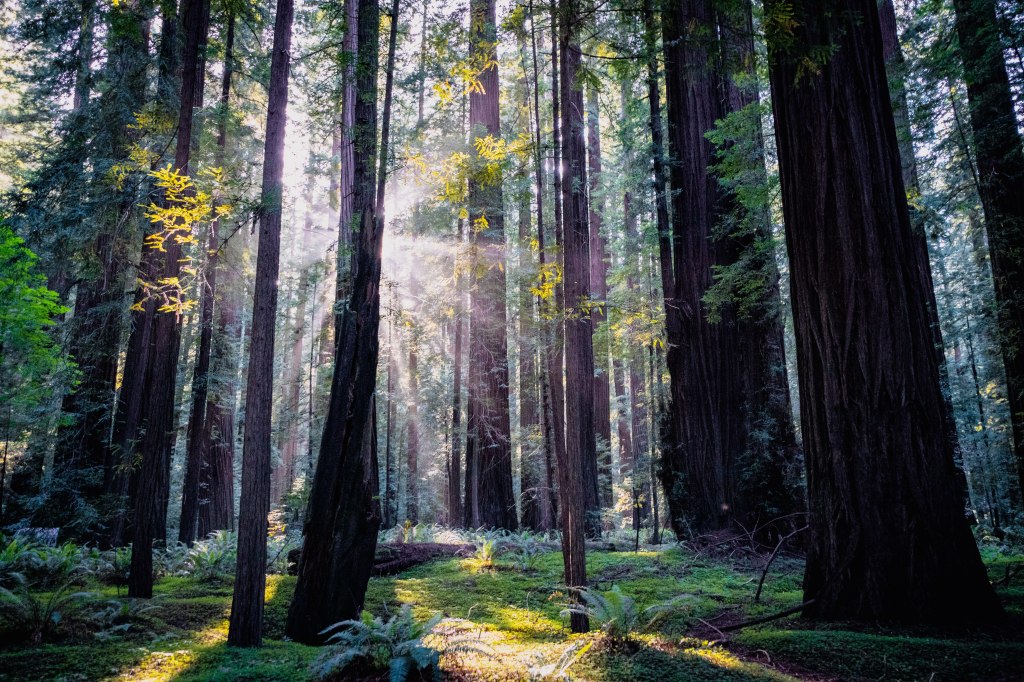
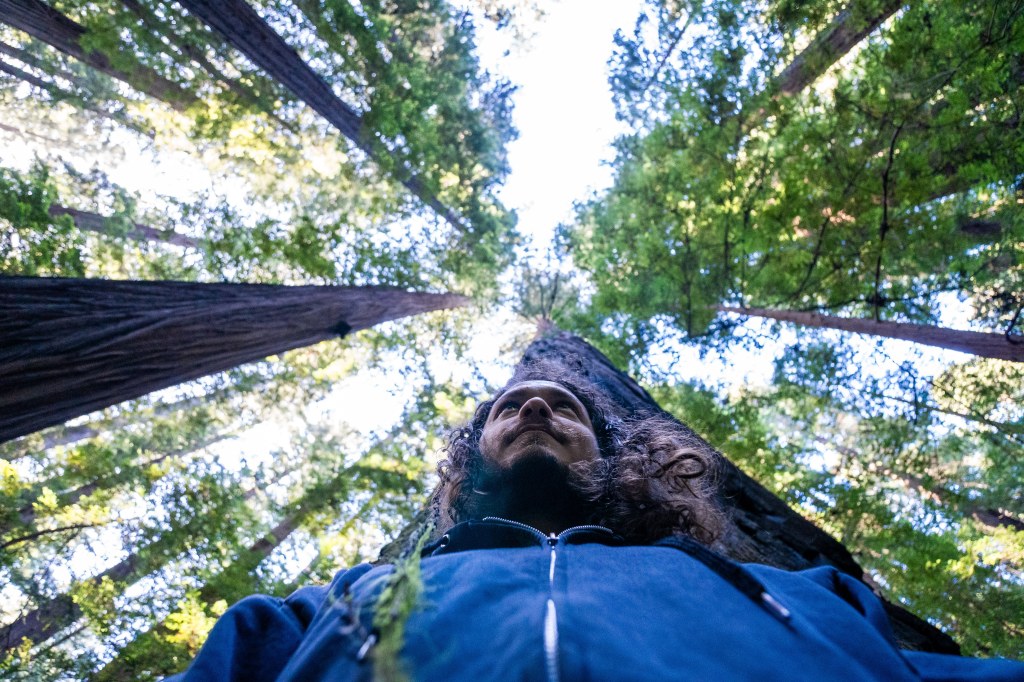
    For years the song sat unfinished. It made it onto several lists of ideas to return to and through several rounds of song-a-week groups without ever getting developed. I never cared enough for it to record a full demo. Then in the spring of 2025 I was traveling the US with my dogs and at the end of a long journey we spent the last few days slowly making our way up the California coast, taking quality time amongst the redwoods of Humboldt and Del Norte counties. It was on a hike through the redwoods that we came across the fallen giant that inspired this final iteration of the song. I wrote some of my thoughts down at the time:


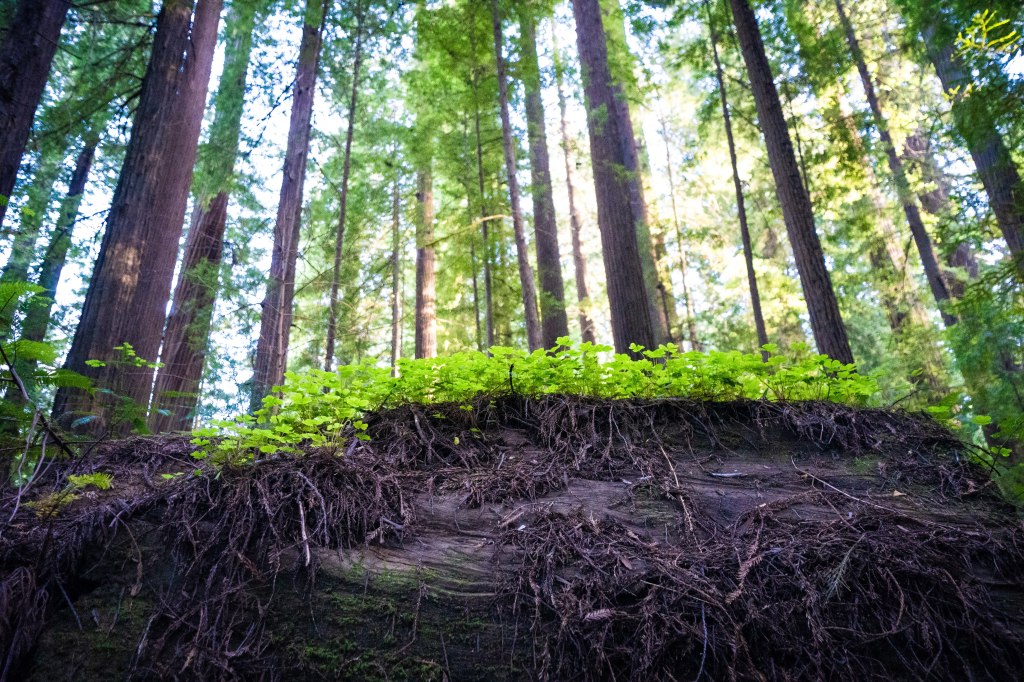
    I was hiking through the California coastal redwoods and came upon a fallen giant. The root system alone was massive – way bigger than me. I marveled at it at first, then walked around the side to see the actual tree, which must have fallen many years ago as its topside was completely covered with ferns, trees, clovers, moss. This tree must have lived at least a thousand years and now in death so much life springs forth – a whole new world growing off its back, with many plants and probably insects and other animals living their lives on and around the corpse of this giant.

    All the nutrients it had acquired in its very long life are released into the ecosystem to feed this new life. It’s beautiful. When we pass we may not be hundreds of feet tall and thousands of years old but the same fate awaits us.

    The bodies we inhabit, the seat of our ego and consciousness, will cease to exist in the static form we know and this transfer of energy and life will begin. The materials that make us up will be broken down and offered up to the environment. And that forward motion of life continues. I believe this is what reincarnation truly is. Compared to a lot of the myths that we’ve known in human history maybe it seems a little anticlimactic or dissatisfying. But it is true. If we decide that all we are is what is being projected from our brains then I don’t think there is anything for us after death. But if we are to identify ourselves with and recognize that we are not separate – that there is no us without our environment – then we can understand that the matter that makes us up is eternal. We will lose our sense of consciousness as we’ve known it, the human ego, memories, all of it will be gone. But what we are on the deepest physical level will remain in some form for longer than the redwood stood. Don’t be confused – just because the brain will cease to exist doesn’t mean it’s all for nothing. Because it’s happening just this once, here and now, it means so much more. We exist.


    Later, during the song-a-week group in the fall of 2025, I started to revisit the tune – which I had previously called Heaven Is Wasted – and was reminded of this new perspective and lesson from the redwood tree on the physical reincarnation of the body. I never really liked the overall lyrics and perspective in the previous version and felt this was something much more interesting and worth exploring. I took my writings from the spring and adapted them to make up the first verses.

    During this time I was visiting Crescent City weekly and taking regular trips to the redwoods around Highway 199 and a couple of trips up the Chetco River to the redwood groves in Oregon. I was searching for other fallen redwoods to sit with and contemplate and write on. I found that I wasn’t writing a lot during those visits – instead I was just reveling in their presence. I didn’t feel too inspired to write anymore on the subject at that point, and although I managed to write the middle section in that time, I didn’t know where the song would go. I sat and wrote the last verse amongst the redwoods in early February 2026 and everything was fleshed out and finalized during the final recording session.

    These days I’ve been splitting my time between Del Norte and Curry Counties, spending time with the redwoods as often as possible.

    In the redwood forest
    I find a fallen giant
    Whose roots tower over me
    Once touched the sky
    Now resting at my feet

    I walk around to take a look
    At the body of an ancient being
    A whole new world grows on it’s back
    And I’m humbled

    It must have lived a thousand years or more
    And now in death it bursts with
    Moss and ferns
    Slugs, birds, berries and clovers
    Salamanders, witches butter
    So much life and so much color

    I won’t live a thousand years
    I won’t grow 400 feet
    I don’t know when I’ll fall
    But when I do, I know what awaits me

    Like the fallen giant
    I will rest where I once stood
    All the little bits that made me up
    Will break down, go back to the earth
    And carry on
    Forever and ever
    Carry on
    Forever and ever

  • Only The Lucky Grow Old

    Only The Lucky Grow Old

    This song was written during the first week of the fall 2025 songwriting group. I was already making progress on another song when this one came to me very quickly one night. I remember having a long day and getting very sick from some sort of caffeinated beverage in the evening. I was running sound at our local venue and sitting at the bar after the show when I had a conversation with an older man – he was at least twice my age. He said jokingly at some point, “I hope I stay young forever.”

    In that moment I felt three things at once: the awareness of my own youth sitting there next to him – I was just 33 years old. Then the awareness of friends who didn’t live much longer than I have, or barely made it past 33. Then the awareness that he was once my age and lived many more years that for me are probable at best, not guaranteed. I felt almost envious in that moment, realizing that I may have the gift of youth in his eyes, but he had the gift of time – time that some friends did not have, and I may not have. With all of this in mind, I replied, “Only the lucky grow old.” As soon as the phrase came to my mind and I spoke those words, I had this feeling: “That’s a good line!”

    After we wrapped up that conversation, I made my way home and the closer I got to the house, the more the caffeine-induced headache intensified. During that short drive, the melody and lines just started coming to me one after the other, and I sang them into my phone as I climbed up the hill. As soon as I got into the house and fed the dogs and cats, I retreated to my room where I shut the door and shut off all the lights. With this headache pounding, I sat down and worked out the entire song in the dark, line by line, working towards the line that inspired the whole thing.

    I was writing about all the things that were weighing heavy on my mind at that time: struggling financially, in serious debt, drowning under the weight of many responsibilities, while also looking at losing essential benefits, and all the while reflecting on the young friends who have lost everything and my own feelings of guilt and regret. The song ended up taking an ironic position – we are the lucky ones who are still here, still breathing, still going, growing older – yet we’re here spending our precious luck stressing about survival.

    After finishing the last lines, I laid down and slept for 10 hours.


    One more letter
    Written halfway
    Crumbled up
    Thrown away
    Just a taste to tease the heart ache

    If there’s a cure
    I ain’t gonna find it
    I never called back
    My therapist
    When they canceled twice
    I tossed their card away

    Come new years I won’t be insured
    Word came down from the billionaires
    They won’t keep floating a broke down bum like me
    When I shoulda been working I was on the road
    I came home when I had nowhere else to go
    I’ve gone broke again seeing how far I could bend

    That little squiggle scratched on the line
    On paper with the land and the man
    My name is not my name but if I don’t pay
    They could take it all away
    Take it all away

    I miss the simple days
    I miss sleeping on the side of the road
    I miss having no home no car no guitars no phone

    If I could go back
    I’d gather up the letters I tossed
    Package them and send em to the friends I’ve lost
    I had one chance and I’ve never been bold
    Only the lucky grow old

    ~~~~~~~~~~~~~~~~~~

    One last thing I would like to share about this song is a recording from my good friend Liam Warden, who sent me a piano and vocal rendition just days after I first recorded it and sent it to him. I prefer his version to my own, and it made me appreciate the song so much more.

  • Perfect Time

    I arrived in Hobart in perfect time on March 20th. I was picked up at the airport by my new friend Dave, the kiwi I had met on Oahu. He took me to his home in Geilston Bay, the address of which is on my Tasmanian ID (valid till 2029). I arrived in the late evening so he got me set up in the guest space and showed me out to a space in the backyard where he kept his music gear. There he left me with the invite to play his drums, basses and acoustic guitar.

    I grabbed the guitar and the very first thing I started playing was this song. Perfect Time started with the intro – the melody and words came all at once:

    You can’t miss when you don’t aim
    Sit still and take it all in

    Guts tame our wounded hearts
    Press our heads to the grumbles

    Just like that I was off with the chord change, and the song dropping into the main section. The lines continued to come to me:

    There’s a song in the distance
    I can’t call the tune
    But I’ll sing what I hear and you can harmonize

    And it continued:

    We may never catch up to the tune
    We may be gone too soon
    But we care not for the future
    Here in perfect time

    All of this came all at once as soon as I touched the guitar. This would become the theme for my arrival on the island in the days to come.

    Around that time, I had been considering that acceptance is essential if I ever wish to be in accordance with reality. Anything and everything that occurs in our universe, for better and for worse, is “meant to be.” All the triumph and tragedy that brings about hope and joy, suffering and despair, is the only law and order in an otherwise chaotic existence.

    I spend plenty of time thinking about the past. Sometimes I’ll allow my mind to trail off to thoughts of what could’ve been – what I could’ve said, what I could’ve done differently, if I’d just kept walking down that road or turned my back on something before it was too late. These thoughts are not helpful, generally speaking. But I was coming back to this idea that I must accept that everything happens in perfect time. Although I could imagine things that could’ve been done to change the course of reality, the fact that something occurred simply means that was the only way it could’ve been. To deny that, to fight it, to try and think my way out of it or around it, would be to break from reality.

    It’s easy to say in moments of hope and optimism that everything happens in perfect time. It’s harder to say when tragedy strikes, when a dear friend is lost too soon, in moments where it sinks in that every living thing must die, recognizing that someday I will have to say farewell to all things.

    I spend so much time trying to make sense of the past, anticipating and predicting the future, yet the only thing that really matters, the only thing that exists, is right now. Right now is not a problem to be solved, only an experience to be had. In the clearest moments, we can settle into that presence, and all fear and anxiety and worry and dread will wash away.

    I had the first chunk of the song for some time, and I played around with it throughout the time I spent on my first trip to Tasmania. But I didn’t end up finishing the song until later in the year when I was back home during one of the song-a-week challenges.

    One cliché says it all: life is full of surprises.
    Don’t know how much time we got
    How many sunrises
    We may never see another moon
    We may be gone too soon
    But we care not for the future
    Here in perfect time

    The song is really quite simple in its scope. My mind goes off into mortality. There’s a layer of melancholy and melancholic contemplation lining the core of my being, rarely without presence in my thoughts. But this song is meant to be a declaration of acceptance – acceptance of our own mortality, an acceptance and letting go of all worry for a future that is not guaranteed, that does not exist, and on some fundamental level, a future that does not concern us.

    I have seen people express this idea that 1,000 years may pass, 10,000 or 100,000 years may pass, eventually everyone we knew, everything we knew, every trace and memory of us may be gone – and therefore, what is the point? But the events of this universe 100,000 years from now are even more meaningless than we could ever be, because we exist. We are here now, and in that, life has great meaning.

    The future is not guaranteed. We understand that the universe will go on, but the future for us, for humanity, for our ancestors, is not guaranteed. What is guaranteed is this present moment, so long as we are here. We exist, and here we shall remain – in perfect time.